CATCH MAINTENANCE EARLY
Damp, leaks, mould, appliance wear, slow drains. The longer they go unspotted, the more they cost to fix. Six-monthly inspections turn surprise repairs into planned ones.



Find tenants fast. Includes **Rightmove** advertising. incl VAT

Get Listed + payment collection, compliance, contract & move-in

We do everything to find you tenants. Only pay on move-in. incl VAT

Fixed fee, dedicated property manager, relets & rolling contract. per month & incl VAT


Accounting & tax solutions with UK Landlord Tax

Our trusted mortgage partners MFB and Habito make financing simple.

Receive up to 10% off appliances from Currys Business and save on ...

Browse insurance products offered by our partner Alan Boswell
It's free. It's yours. And it's designed to make renting better.


Furniture savings to help you settle in

Utility switching made quick and easy

First-time buyer mortgage advice for your future
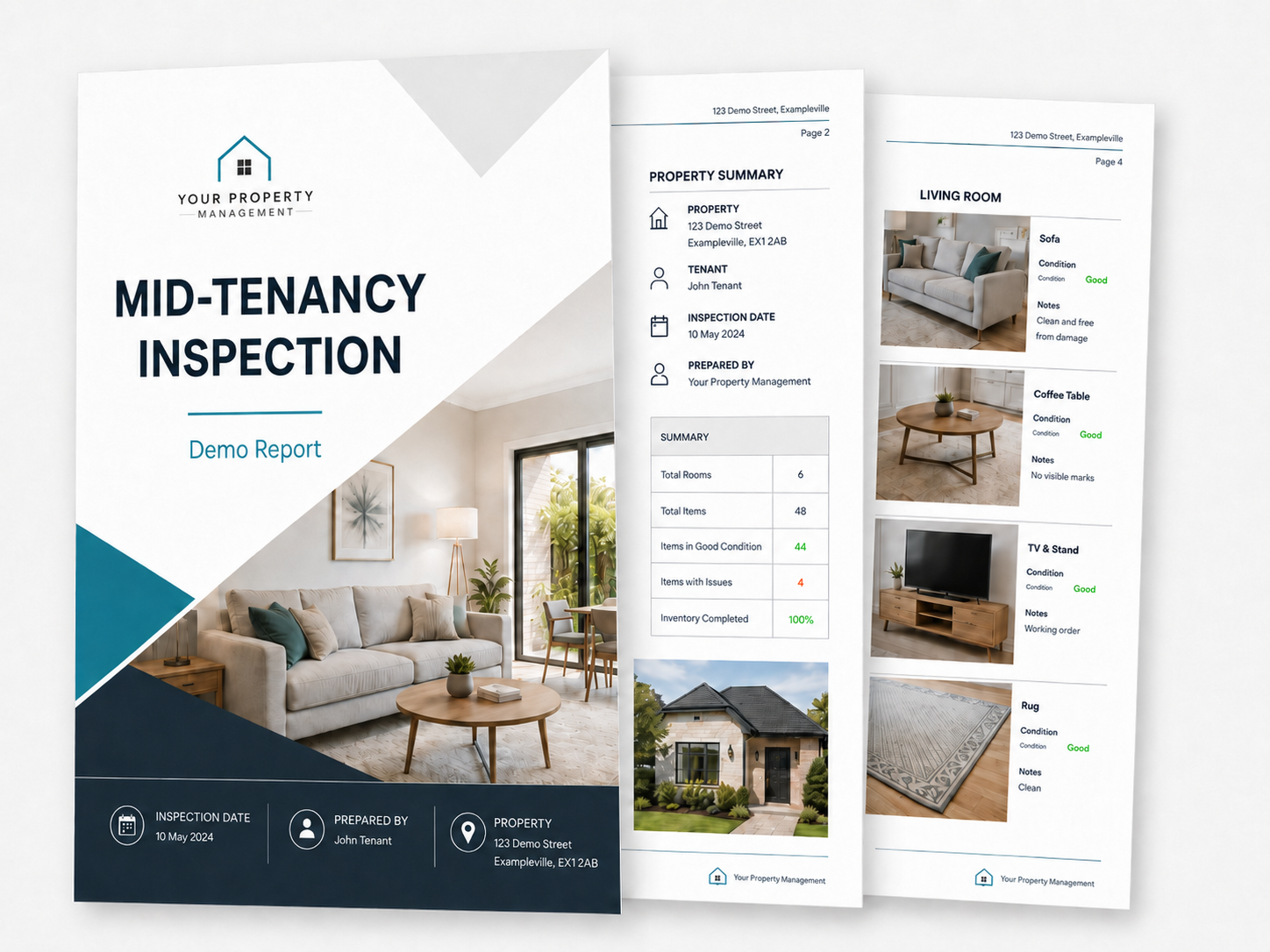
Independent visual inspections by your property manager. Photographic evidence of every room, garden, and external area. A written report you can share with your insurer or use in a deposit dispute. £85 per visit, delivered within 48 hours.
Independent visual inspection by a property manager. Photographic report delivered within 48 hours. Most landlords book one every six months.
Book an inspectionRequest to book
Your details
No payment taken now. We'll confirm everything by email before invoicing.
Thanks{first_name_token}. We've got your request and a member of staff will be in touch within one working day to confirm details and arrange payment.
A property left unchecked between move-in and move-out is a property accumulating small issues. Most of them are cheap to fix in month six and expensive to fix in month sixteen. A mid-tenancy inspection is the single most cost-effective piece of landlord admin you can do.
Damp, leaks, mould, appliance wear, slow drains. The longer they go unspotted, the more they cost to fix. Six-monthly inspections turn surprise repairs into planned ones.
Most landlord insurance policies expect documented periodic inspections as a condition of cover. The same reports double as deposit-dispute evidence at end-of-tenancy.
Local authorities, mortgage lenders and selective licensing schemes all expect active landlord oversight. A documented inspection trail is the cleanest possible proof.
Mid-tenancy inspections aren't for every landlord. They're for the ones who can't see the property themselves, want a second opinion that isn't their agent's, or have a feeling something's off and want it on the record. If none of those land, you probably don't need one.
You own properties in places you don't live. The Manchester flat. The Bristol terrace. You signed the tenants up over a year ago and haven't been inside since.
Your letting agent inspects already. You'd like a second set of eyes whose paycheque doesn't depend on telling you everything's fine.
Rent's paid, but something's not adding up. An undeclared pet, a face you don't recognise, a neighbour comment you can't shake. A calm walk-through, on the record, before it becomes a problem.
Your landlord insurance makes periodic inspections a condition of cover, and you'd like the documentation handled properly rather than improvised.
Inspections are already included on Management Complete and Management Plus, scheduled twice a year as part of the service. No separate booking needed.
You visit each property every six months yourself, with photos and notes. The independent third-party angle still has value for deposit disputes, but it isn't urgent.
You can see the property from your window and the tenant is in regular contact. A formal report adds documentation, not visibility.
Hello Neighbour inspections work in two stages. First, an in-house inspector attends the property and documents everything — every room, every photograph, every alarm test, every conversation with the tenant. Then an ARLA-qualified property manager reviews the report before it lands in your inbox. Nothing goes out unchecked.
We inspect 950 properties twice a year. After enough visits, the patterns become obvious. We know which kinds of damp are getting worse, which "small issues" are quietly costing landlords thousands, and which tenant behaviours signal trouble worth flagging early. The PMs reviewing your report have seen it all.
.png)


A Hello Neighbour PM team member attends the property with proper written notice to the tenant. They walk every room, photograph what they find, test smoke and CO alarms, check the exterior, garden and any outbuildings, and have a brief conversation with the tenant about anything they've noticed since moving in.
Everything is documented. Damp, condensation and ventilation get particular attention because they're the issues most landlords don't hear about until check-out. Unauthorised occupants, undeclared pets, and structural changes are flagged plainly.
The full report is delivered to your inbox within 48 hours of the visit, with photos, observations, and any recommended actions. It's yours to file, forward to your insurer, or use in a future deposit dispute.
Most landlords book one inspection for the six-month mark and another at twelve. Here's the flow from booking to report.
Two-minute online booking. Pick your date, pay by card, we handle the rest.
Proper written notice with the visit window. No surprises, no awkwardness.
A Hello Neighbour inspector walks the property, photographs, tests alarms, talks to the tenant, ARLA qualified PM reviews .
Cloud-delivered within 48 hours. Ready to file, forward to your insurer, or keep for the future.
There's no statutory requirement, but most UK landlord insurance policies make periodic inspections a condition of cover. Mortgage lenders with buy-to-let products often have similar expectations, and local authorities operating selective licensing schemes increasingly look for a documented inspection trail.
The practical answer: no, you don't legally have to, but if you ever need to claim on your insurance or defend a deposit dispute, the inspection record is what makes the difference.
Twice a year is the standard, usually at the six-month and twelve-month marks. Some insurers and licensing schemes ask for quarterly, especially for HMOs or higher-risk properties.
For most single-let tenancies, six-monthly is the right balance between cost and oversight. Often enough to catch issues early, infrequent enough not to feel intrusive to the tenant.
We give proper written notice in line with the tenancy agreement, which gives you the legal basis for access. But we can't and won't force entry. If access is refused, we log the attempt, reschedule once at no extra cost, and flag it clearly in the report so the refusal is on record.
Repeated refusals are unusual and almost always have a reason worth understanding. We'll talk you through what we found and what your options are.
An inventory is the start-of-tenancy benchmark — a detailed photographic record of how the property was on day one. It's the document a deposit adjudicator compares against at check-out.
A mid-tenancy inspection is the check against that benchmark while the tenancy is live. Different jobs, both worth having. The inspection catches issues early so they can be fixed before they become deposit deductions.
Yes — both. Management Complete and Management Plus both schedule mid-tenancy inspections twice a year as standard, with reports filed and actioned by your property manager. There's no separate booking and no separate fee.
If you're already on either, you don't need to book through this page. If you're managing yourself but letting more than one property, fully managed often works out cheaper than ordering services one at a time.
Every property is different and we'd rather help you pick the right service than push the wrong one. Speak to a real person about your tenancy, your timing, and what makes sense for your situation. No pressure, no upsell.
A mid-tenancy inspection is the cheapest piece of landlord admin that pays for itself. Most of our customers book at the six-month mark and again at twelve.
Letting more than one property? Inspections are included on Management Complete and Management Plus, scheduled automatically twice a year.