













In short: an EICR is a legal requirement for rented homes in England, renewed every five years and carried out by a qualified electrician. Hello Neighbour arranges them for £175 including VAT.
Updated 19 September 2026
If you let a property in England, the Electrical Installation Condition Report, or EICR, is one of those bits of paperwork you cannot afford to get wrong. The good news is it is not complicated once you understand what it is, who can do it, and what to do with it afterwards. This guide walks through it all, with a look at how Hello Neighbour has handled the 1,220 EICRs it has done for the landlords we work with.
The key facts
- Every five years. Rented homes in England need an electrical inspection at least every five years, against BS 7671. Electrical Safety Standards Regulations 2020.
- 28 days for remedial work. C1, C2 or FI codes mean fixes within 28 days or sooner, with written confirmation afterwards.
- Up to £40,000. The maximum civil penalty for breaches rose under the Renters' Rights Act 2025.
- 48.7% need work. Roughly one in two EICRs Hello Neighbour has managed in 2026 came back with remedial items, averaging £702 to fix.
- Copies within 28 days. Tenants get the report within 28 days (new tenants before move-in); the council within 7 days of a request.
In this article:
- EICR summary
- What is an EICR?
- Why do EICRs matter for landlords?
- Who can carry out an EICR?
- What is an ECS card?
- How to check an electrician's competence
- How to prepare for an EICR inspection
- What do EICR codes C1, C2, C3 and FI mean?
- Who needs a copy of the EICR?
- How long does an EICR last?
- EICR regulations across the UK
- How Hello Neighbour arranges EICRs
- EICR key takeaways
A quick word of warning before we start. Most landlords’ first EICRs were carried out in the rush following 1 April 2021, when the regulations were extended to all existing tenancies. Those certificates last five years, which means a huge wave of them is expiring around April 2026. Please check the expiry date on your current certificate now. If it is within the next few months, do not wait. If you want us to get it renewed book yours with Hello Neighbour here for £175 inc VAT. And we will take care of the rest.
https://www.hello-neighbour.com/eicr-certificate
EICR summary
- An EICR is a legal requirement every five years in England, and across most of the UK in some form
- The work must be carried out by a qualified and competent electrician. Checking for NICEIC or NAPIT registration, or an ECS card, is the simplest verification
- If your electrician is not scheme-registered, use the competence checklist above
- A report is either Satisfactory or Unsatisfactory. C1, C2 or FI codes mean remedial work within 28 days
- Tenants must get a copy within 28 days (new tenants before they move in), and the council within 7 days of request
- The maximum civil penalty is rising to £40,000 for offences from 1 May 2026
- Most certificates issued during the April 2021 rollout are expiring now, so check yours today
If you have questions about EICRs, compliance, or anything else to do with letting or managing a property, get in touch. https://www.hello-neighbour.com/contact
What is an EICR?
An EICR is a formal safety inspection of the fixed electrical installations in a property. That means the consumer unit (fuse box), wiring, sockets, switches, light fittings, earthing and bonding. It does not cover plug-in appliances like kettles or lamps; those fall under PAT testing, which is a separate inspection.
A qualified electrician carries out both a visual check and live testing using specialist equipment, then issues a written report grading the installation as either “Satisfactory” or “Unsatisfactory”. The standard being measured against is BS 7671, the 18th Edition of the IET Wiring Regulations.
As Hello Neighbour puts it on our own EICR page, the goal is straightforward: we check for potential fire and shock risks, identify electrical defects, and test every fixed electrical installation in the property, including lighting, plugs and sockets, so you know whether everything is safe and in working order.
Why do EICRs matter for landlords?
There are three reasons to take EICRs seriously.
The legal one. Since 1 July 2020, a valid EICR has been a legal requirement for all new private tenancies in England, and it was extended to existing tenancies from 1 April 2021. The rules sit inside the Electrical Safety Standards in the Private Rented Sector (England) Regulations 2020. Get it wrong and the maximum civil penalty has risen to £40,000 under the Renters’ Rights Act 2025. It is also one of the certificates to have in hand when getting a property ready to let.
The insurance one. Most landlord insurance policies require a valid EICR. Without one, a claim related to an electrical fire could be refused.
The human one. Faulty wiring kills roughly 60 people a year in the UK and causes thousands of fires. An EICR is the simplest way to know your tenants are safe, and to evidence that you have met your duty of care if anything ever goes to court.
Who can carry out an EICR?
The Regulations require the inspection to be done by a “qualified and competent person”. That phrase does a lot of work, so it is worth unpacking.
At Hello Neighbour, we look for an electrician who can demonstrate:
- NVQ Level 3 or equivalent in electrical installation
- Current knowledge of BS 7671 (the 18th Edition Wiring Regulations)
- Competence in inspection and testing, typically the City & Guilds 2391 qualification (or the 2391-52 variant specifically for periodic inspection)
- Professional indemnity and public liability insurance
Beyond qualifications, registration with a recognised scheme is the quickest way to verify someone is the real deal. The main ones are:
- NICEIC, the National Inspection Council for Electrical Installation Contracting
- NAPIT, the National Association of Professional Inspectors and Testers
- ECA, the Electrical Contractors’ Association
NICEIC tends to be the most widely recognised by letting agents, insurers and councils, but NAPIT is equally valid in law. Both are accepted under the Regulations.
What is an ECS card?
An ECS card (Electrotechnical Certification Scheme) is the individual electrician’s proof of identity, qualifications and competence on site. Unlike NICEIC or NAPIT, which register a business, the ECS card sits in the electrician’s wallet and is tied to them personally. Ask to see it on the day. It is one of the simplest checks a landlord can do.
To check the card is still valid you can use this link.
https://www.ecscard.org.uk/ecs-check-card-search
What does an ECS card look like?
The ECS card printing system has recently been updated, which means cards printed now and in the future have a slightly different look to those cards issued before the change in system.
ECS cards issued from the new system display a full colour ECS logo on the front and a barcode on the back. The back of all new cards are white, regardless of the colour on the front of the card. The new cards are also laminated for better durability.
The layout of ECS cards is identical for all card types.
New Style Card (left) and Existing Style Card (right)
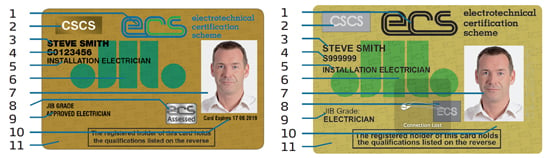
Key - 1. The ECS logo 2. The CSCS hologram shows the ECS scheme is partnered with the CSCS card scheme 3. The cardholder's name 4. The cardholder's card number 5. The cardholder's occupation/s 6. The JIB logo will appear for cardholders who have a JIB grade 7. A photo of the cardholder 8. If the cardholder has successfully passed the ECS Health & Safety requirements, the ECS Assessed hologram will be shown here 9. If the cardholder has a JIB grade it will be shown here 10. The card's expiry date 11. If a logo appears here it shows the card is also linked to an ECS partner association
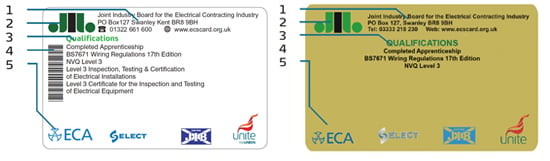
The reverse of the card shows: 1. The JIB's contact details. 2. The JIB logo 3. The cardholder's qualifications (not all card types) 4. A unique bar code (new style card only) 5. The logos of the ECS card partners
New Style Card Reverse (left) and Existing Style Card Reverse (right)
How to check an electrician's competence
The law does not actually require scheme membership. It requires competence. So if you have found an experienced electrician who is not on a scheme, you can still use them, but you must verify their credentials yourself. GOV.UK guidance suggests asking them to sign a checklist confirming their competence. Here is one you can copy and send.
Sample electrician competence checklist
*Property address: ………………………………………………*
*Inspection date: …………………………………………………*
I confirm that I am qualified and competent to carry out an Electrical Installation Condition Report (EICR) at the above property, in line with the Electrical Safety Standards in the Private Rented Sector (England) Regulations 2020.
Please tick and complete each item:
☐ I hold a current qualification covering the 18th Edition of the IET Wiring Regulations (BS 7671). Qualification: …………………………
☐ I hold a current qualification in the periodic inspection, testing and certification of electrical installations (e.g. City & Guilds 2391 or 2391-52). Qualification: …………………………
☐ I have at least ……. years of experience carrying out EICRs on residential properties.
☐ I hold valid **public liability insurance** of at least £2 million. Insurer: …………………………….
☐ I hold valid **professional indemnity insurance** of at least £250,000. Insurer: …………………………….
☐ My test instruments hold current calibration certificates.
☐ I am a member of the following competent person or trade scheme (if any): …………………………….
Signed: ……………………………………………….
Print name: ………………………………………….
Date: ………………………………………………..
Keep the signed checklist with the EICR itself. It is your evidence, if anything ever comes up, that you took reasonable steps to verify the inspector’s competence.
How to prepare for an EICR inspection
An EICR is not a quick walk through. The electrician will need access to every room, plus the consumer unit and meter cupboard, and the power will need to be switched off for parts of the testing. For an average property with a single consumer unit and no issues, expect it to take half a day or so.
A bit of preparation makes the visit go more smoothly:
- Move furniture or stored items blocking sockets, the fuse box or the meter
- Dig out any previous EICR or electrical certificates so the inspector can see history
- Fix obvious small issues beforehand, like cracked sockets or broken switch plates, to avoid easy C2s on the report
- confirm a time in advance with your tenants and let them know that the power will go off intermittently
The inspector will then test every circuit, inspect sockets and fittings, confirm earthing and bonding are correct, test RCD (residual current device) safety switches, and compare what they find against current standards.
What do EICR codes C1, C2, C3 and FI mean?
Every EICR uses the same coding system to flag problems. This is the bit that is most confusing, so it is worth being precise:
- C1, Danger Present. Risk of injury. Fix immediately; the electrician may make it safe before leaving.
- C2, Potentially Dangerous. Urgent remedial work required.
- C3, Improvement Recommended. Not unsafe and not legally required to fix, but worth doing.
- FI, Further Investigation. More checks needed before safety can be confirmed.
A report is only Satisfactory if there are no C1, C2 or FI codes. C3s on their own do not fail the report. If you do get an unsatisfactory result, the remedial work must be done within 28 days (or sooner if the report specifies), after which you need written confirmation from the electrician that the installation now meets the standard.
The most common problems electricians flag, and these are real-world examples we see at Hello Neighbour, include old consumer units without RCD protection, inadequate earthing or bonding (especially in kitchens and bathrooms), damaged sockets and switches showing signs of overheating, DIY alterations that have not been properly earthed, and overloaded circuits with poor documentation.
It is worth budgeting for improvements. Roughly one in every two EICRs Hello Neighbour has managed this year has come back with something that needs fixing (48.7% so far in 2026, with an honest range of around 42% to 49% once you account for follow-ups still in flight). The average cost of that remedial work is £702.
Who needs a copy of the EICR?
Once you have your report, the Regulations are very specific about distribution. You must:
- Give a copy to existing tenants within 28 days of the inspection
- Give a copy to new tenants before they move in
- Give a copy to the local authority within 7 days if they request one in writing
- Provide a copy to any prospective tenant within 28 days of a written request
- Keep a copy until the next inspection and hand it to whoever does that next inspection
If remedial work was needed, you must also send written confirmation that the work has been done to both your tenants and the local authority within 28 days of completion.
Storage matters too. Digital copies are accepted, but keep them somewhere you can actually find them. Councils, courts and tenants can all ask to see one, and “I had it but I cannot find it” is not a defence. A dated folder per property works well.
How long does an EICR last?
The standard validity is five years, unless the report itself specifies a shorter interval (some installations warrant earlier re-testing and the inspector will say so on the report).
As we flagged at the beginning we are just past the five-year anniversary from 1 April 2021 when EICRs became mandatory for all existing tenancies, not just new ones. That created a surge of inspections in spring 2021. Those certificates are now hitting their five-year expiry, which means we are in the middle of a significant renewal moment for landlords in England. Please check the expiry date on your current certificate today. If it is within the next few months, get it booked. Local authorities are paying close attention, and a lapsed EICR is one of the easiest things for them to spot. Hello Neighbour can arrange yours here (https://www.hello-neighbour.com/eicr-certificate).
One myth worth busting: some certificates state they are valid for 5 years or until change of tenancy. This is incorrect. The Regulations require testing at specified intervals, not on tenancy turnover, so a change of tenant does not invalidate a current EICR. If you see that wording on a report, raise it with the electrician.
It is also worth getting a new EICR sooner if:
- Major electrical work has been carried out
- Tenants raise concerns about the electrics
- The property has suffered damage (flood, fire, etc.)
- You have just bought a rental property and there is no recent report available
EICR regulations across the UK
The headline regulation is the Electrical Safety Standards in the Private Rented Sector (England) Regulations 2020, with the standard for installations set by BS 7671 (18th Edition). But it does not sit alone:
- The Housing Health and Safety Rating System (HHSRS) lets councils take action on serious electrical hazards independently
- Part P of the Building Regulations governs notifiable electrical work in dwellings
- The Electricity at Work Regulations 1989 places duties on anyone with control of an electrical system
- From 1 May 2026, the Renters’ Rights Act 2025 converts existing ASTs into periodic tenancies. Your EICR obligations remain identical, but the civil penalty ceiling lifts to £40,000
Outside England, the picture varies:
- Scotland, five-yearly EICRs are required under the Housing (Scotland) Act 2014
- Wales, broadly similar rules under private rented sector legislation
- Northern Ireland, became mandatory for new tenancies in April 2025, with existing tenancies from 1 December 2025
- Social rented sector in England, five-yearly EICRs became mandatory for new tenancies from 1 November 2025, and for existing tenancies from 1 May 2026
How Hello Neighbour arranges EICRs
Compliance is one of those jobs where the cost of getting it wrong vastly outweighs the cost of doing it. That is why we built our EICR service the way we did.
We have arranged over 1,200 professional EICRs with a certified electrician for £175 inc. VAT. We also include it as part of our Property Management Plus package. We coordinate with your tenants for access, share the report with you and the tenants, and track the renewal date so you get a reminder in good time rather than discovering an expired certificate the hard way.
If the report comes back unsatisfactory, we manage the remedial work too, get written confirmation once it is fixed, and make sure the local authority and tenants receive the right paperwork. The whole thing is designed so you do not have to think about it again until the next renewal, which, of course, we also handle.
EICR key takeaways
- An EICR is a legal requirement every five years in England, and across most of the UK in some form
- The work must be carried out by a qualified and competent electrician. Checking for NICEIC or NAPIT registration, or an ECS card, is the simplest verification
- If your electrician is not scheme-registered, use the competence checklist above
- A report is either Satisfactory or Unsatisfactory. C1, C2 or FI codes mean remedial work within 28 days
- Tenants must get a copy within 28 days (new tenants before they move in), and the council within 7 days of request
- The maximum civil penalty is rising to £40,000 for offences from 1 May 2026
- Most certificates issued during the April 2021 rollout are expiring now, so check yours today
If you would like Hello Neighbour to arrange yours, you can book it here: Hello Neighbour Services - EICR. And if you have questions about EICRs, compliance, or anything else to do with letting or managing a property, get in touch Contact Hello Neighbour
Sources: GOV.UK guidance on electrical safety standards in the private and social rented sectors; Electrical Safety Standards in the Private Rented Sector (England) Regulations 2020; NRLA guidance on electrical safety inspections; NICEIC; NAPIT; Hello Neighbour service pages and insights.
COMMENT