Since the Renters' Rights Act took effect on 1 May 2026, tenants across England have challenged rent increases at the First-tier Tribunal in their hundreds, and every decision is published. We have read all 336 decisions published to 11 November, and the lesson for landlords is the same in every region: the tribunal sets an open market rent, and a detailed, evidence-based valuation is the key to winning at tribunal.
The starting point before you serve a section 13 notice is to get a detailed valuation: get your free detailed valuation, and if you want us to manage the section 13 process, just get in touch. Call us on 020 8138 8848 or email contact@hello-neighbour.com.
Updated 17 November 2026
The key facts
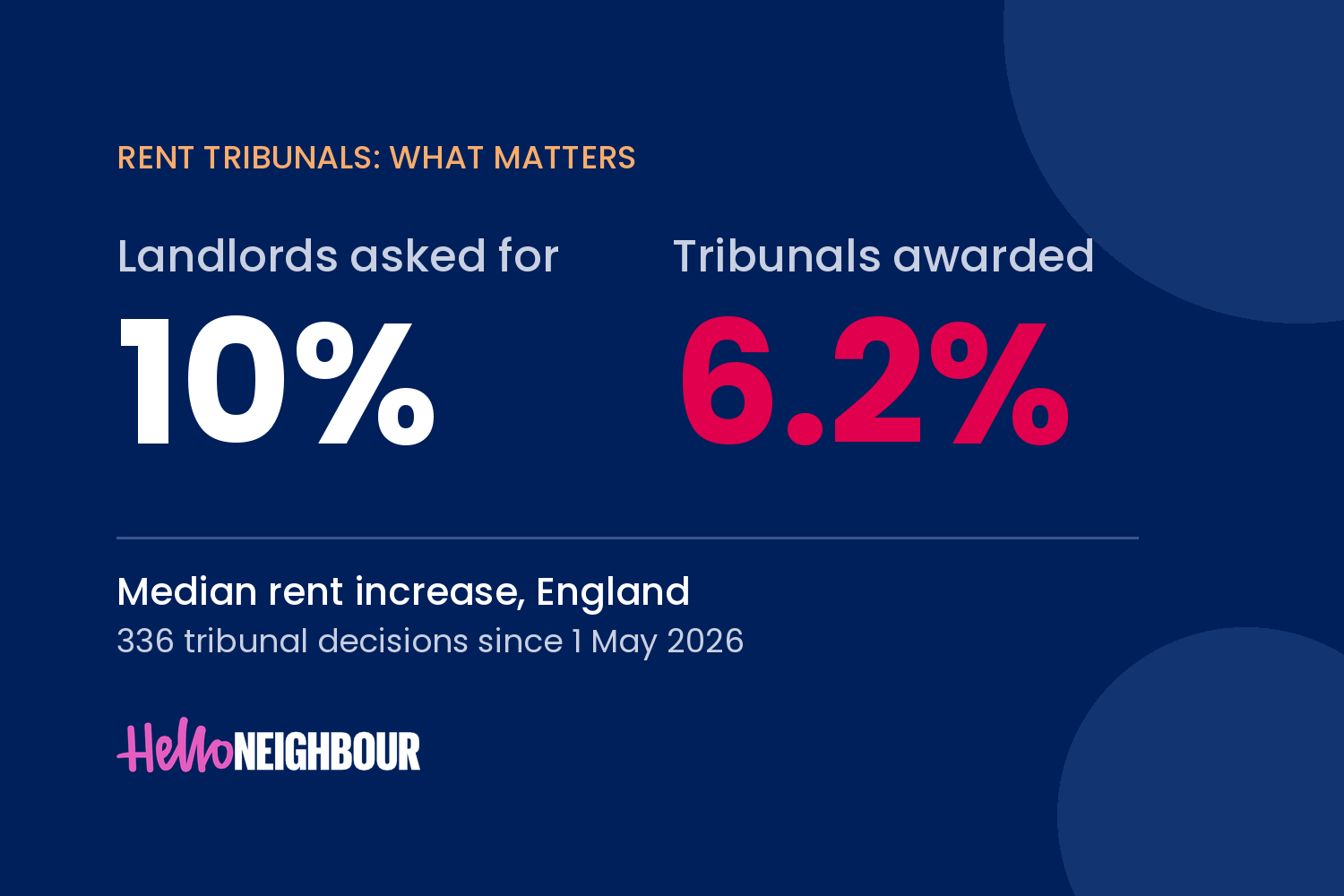
- Asked for 10%, awarded 6.2%. The median increase landlords proposed, against the median the tribunal awarded. Hello Neighbour analysis of 336 decisions, 1 May to 11 November 2026.
- Rent went up in 79% of decisions. Only 35% of landlords were awarded the full increase in their notice. Same analysis.
- 31 cases lost on process. The notice failed or the case was struck out before any valuation, 20 of them in London. Same analysis.
- 109 days. The median time from notice to decision, with most cases between 85 and 135 days. Same analysis.
In this article:
- What have tribunals decided?
- How do the regions compare?
- Why did 20 tenants end up paying less?
- How does a tribunal arrive at a figure?
- Which comparables carry weight?
- Do floor areas matter?
- What about location, schools and transport?
- Does hardship change the rent?
- How do you serve a section 13 increase that survives a challenge?
- What should a landlord's evidence pack contain?
- Before you serve a notice
- Frequently asked questions
- About this analysis
- Sources
What have tribunals decided?
Of the 336 decisions published between 1 May and 11 November, 300 set a rent. 31 did not reach a valuation because the landlord's notice was invalid or the case was struck out, and the remainder were withdrawn, superseded or involved notices served before 1 May.
| Measure |
Result |
| Decisions setting a rent |
300 |
| Rent went up |
237(79%) |
| Landlords awarded their full proposed rent |
105(35%) |
| Rent stayed at the existing level |
43 |
| Rent set below the existing level |
20 |
| Median increase proposed by landlords |
10.0% |
| Median increase awarded |
6.2% |
| Median share of the proposed increase the landlord kept |
67% |
| Market rent found above the landlord's proposal |
43 cases |
| Cases lost on process before any valuation |
31 |
| Decided on paper, without a hearing |
270 |
| Median time from notice to decision |
109 days |
Most landlords lost part of their increase, usually because the panel found the evidence too thin to support the full figure. In 43 cases the panel's own view of market rent was higher than the landlord had asked for, so the rent was held at the landlord's lower figure. Under the new rules a tribunal cannot award more than the landlord proposed, as the tenant notes on Form 4A make clear.
How do the regions compare?
The pattern is the same everywhere, but the size of the award is not.
| Region |
Rents set |
Median increase proposed |
Median increase awarded |
Full proposed rent awarded |
| North (Northern tribunal region) |
81 |
15.4% |
9.4% |
40% |
| London |
109 |
8.1% |
5.6% |
39% |
| East (Eastern region) |
33 |
10.0% |
7.0% |
27% |
| Midlands |
28 |
10.9% |
5.3% |
29% |
| South and South West (Southern region) |
49 |
8.0% |
3.0% |
29% |
Northern landlords asked for the largest increases and kept the most of them. In the Southern region the median landlord kept only 42% of the increase proposed. London stands out for process: 20 of the 31 cases lost on paperwork were London cases, around one in seven of all London decisions, against one in twenty elsewhere.
Getting the figure right matters more in a rising market. Our London letting market report for October, published on 3 November 2026, found advertised rents on the Greater London properties we market were up 7.6% on a year earlier, at an average of £2,401. However, on the London properties we listed from August to October that have since let, the agreed rent came in 4.4% below the advertised rent, and a tribunal looks for what comparable properties actually let for as its starting point.
Why did 20 tenants end up paying less?
In 20 cases a landlord served a notice to increase the rent and the tribunal set it below what the tenant was already paying: seven in London, six in the Southern region, three each in the North and Midlands, and one in the East. A section 13 notice opens the rent to a full market valuation, and the cap at the landlord's figure only works in one direction.
The reasons fall into four groups. In five cases, including Southwark, Havering, Bath, Bracknell and Maidstone, the landlord submitted no evidence, so the tenant's comparables or the panel's own knowledge went unchallenged. In Southwark a furnished flat in Elephant and Castle fell from £2,560 to £2,350 on seven nearby listings put in by the tenant.
In several more, the panel deducted for condition or disruption the landlord had not addressed: damaged common parts in Barking, cladding works and scaffolding in Southwark, a dated kitchen and outstanding repairs in Tonbridge, worn carpets and poor decoration in Southampton, and outstanding defects with an EPC rating of E in Harborne, Birmingham.
In others the landlord's own evidence was turned against it. In Rochdale the landlord relied on agreed renewals with sitting tenants, and the panel preferred the landlord's own adverts for identical flats at lower rents, observing that sitting tenants tend to accept increases "being fearful of losing their home". The rent went from £1,000 to £990.
In the rest, the existing rent was simply above the market. At a build-to-rent block in Haringey the panel valued the studio without the incentives being offered to fill empty flats, and in Barnet the tenant's comparables in the same development, with floor areas, beat the landlord's two undated listings. Before serving a notice on a property let at or near the top of the market, a landlord should be confident the evidence supports the current rent as well as the new one.
How does a tribunal arrive at a figure?
The panel asks what the property would let for on the open market today, to a new tenant on the same terms. It decides from the papers in almost every case, and it is entitled to use its own knowledge of local rents alongside whatever the parties send. GOV.UK's guidance for tenants is clear: the tribunal combines the evidence with its own expertise.
In practice that expertise is often the main factor in the decision. Only 73 of the 300 figures were built directly from named comparables. In 173, the panel discussed the comparables and then set its own number, and in 53 there was nothing usable in front of it at all. Where neither side produces evidence, the outcome is close to a guess on the landlord's behalf. At Windward Court in Newham the landlord produced no evidence for a £2,200 rent, and the panel, relying on its general knowledge, left it at the existing £2,050.
Panels can also decide the landlord's number is too low. In Preston the landlord's own agent had recommended £900 a month for a house let at £625; the landlord asked for £725, the tribunal assessed the market rent at £900, and it could award only £725. In Enfield the tribunal confirmed a market rent of £2,200 against a proposed £1,800. Across England, 43 landlords asked for less than the tribunal thought the property was worth. Pricing an increase cautiously to avoid a challenge can simply leave money on the table, because the tribunal cannot correct a figure upwards. Get a free detailed valuation here.
Which comparables carry weight?
Comparable properties and the rent paid for them are used by both tenants and landlords. One side or the other put advertised rents or a portal price guide in 247 of the 300 decisions, often as Rightmove or Zoopla screenshots or an agent's "Best Price Guide". Achieved lettings appeared in only 139. Panels treat listings as a guide to the general level of the market. A Greenwich tribunal spelled out why this matters more since 1 May: with rental bidding banned, a property can now let only at or below its advertised rent, so an asking price is a ceiling rather than evidence of open market rent.
The evidence that tends to win is a recent letting, close by, of a similar property. At Skylark Point in Stratford, Get Living submitted nine agreed lettings in the same development from the weeks around the valuation date, and the tribunal awarded its full proposed rent because these were rents actually achieved. At Trinity Tower on the Isle of Dogs, by contrast, the landlord relied on a Best Price Guide of nearby asking rents, produced no completed lettings, and was cut from £3,600 to £3,450.
Not every "achieved" rent counts. Several panels outside London gave little weight to rents agreed at renewal by sitting tenants, or to a landlord's internal rent reviews across its own portfolio, because these are not open market lettings. A Watford landlord relied on an AI-generated rental assessment that named no properties, and the tribunal gave it limited weight.
Proximity matters as much as type. Same-building or same-development evidence appeared in 62 decisions, and panels repeatedly preferred the comparables nearest the property. A Romford landlord's agent submitted a dozen achieved lettings, but they were two-bedroom flats and the property had one bedroom, and the panel largely ignored that evidence.
When a panel gave a piece of evidence less weight, the reasons were as follows:
| Reason evidence was discounted |
Times cited |
| No address, date or supporting detail |
131 |
| Different size, type or specification |
117 |
| An asking rent, not an achieved one |
64 |
| Undated or out of date |
37 |
| Too far away or in a different market |
29 |
Almost every one of those is fixable before the papers go in. Several panels also made clear they will not follow web links, so evidence needs to be on the page, not behind a URL.
Do floor areas matter?
Floor area is the most common gap in the evidence. In about seven in ten of the 300 decisions the comparables put forward carried no floor areas, which leaves the panel unable to say whether a flat down the road is bigger, smaller or the same. Rates per square foot or square metre were used in only a handful of cases, and they were decisive when they were. In the Kensington and Chelsea case that was reheard in October, the landlord's schedule of comparables with floor areas and rates per square metre took the rent to the full £1,000 a week proposed, after a first decision based on the tenant's listings had been set aside. Tenants have noticed too: a Camden tenant adjusted each comparable by price per square foot to argue the figure down.
The way panels value explains why this matters. Where a decision sets out the working, the panel takes a starting rent for the property in good, modernised condition and then deducts for every shortfall. Deductions of this kind appear in 134 of the 300 decisions. They are specific: £400 in Camden for a dated kitchen and bathroom, worn floor coverings and cracking; £175 in Bath for damp, mould and single glazing; £80 in Southwark because the comparables had en-suites and the flat did not; £50 in Havering for the absence of landlord's white goods.
No panel in England added a premium for a quality of the property itself. The only additions were for services the landlord supplies, such as heating or water included in the rent. We think this is an opportunity for landlords. Tenants tend to itemise what is wrong with the property and the panel then prices it accordingly. Landlords rarely say what is better about their property than the comparables, but they should.
What about location, schools and transport?
Another opportunity is that so far property location barely features in the reasoning. Schools are mentioned in 13 of the 300 decisions, and a school catchment in three. Stations and transport links appear in 97, almost always in the description of the property rather than as an argument about value. Shops and local amenities come up in 132 decisions without being priced.
Panels handle location through the choice of comparable instead: a property in the same block or street is taken to share its location, and anything further away is discounted. That works when the comparables are close. It breaks down when the best evidence is half a mile off, on the far side of a station, or outside a school catchment that we know tenants pay for. A landlord in that position should make this clear, with the evidence: the walking time to the station, the catchment, the distance of each comparable.
Our own free valuation report scores these external factors, transport, amenities and crime, alongside the comparables, so the location case is on the page from the start.
Does hardship change the rent?
No. Hardship can only delay the date the new rent starts, by up to two months after the decision, under section 14ZB of the Housing Act 1988 as inserted by section 7 of the Renters' Rights Act 2025. The amount is the open market rent regardless of either party's circumstances. Tenants asked for a deferral in 168 of the 300 decisions and 10 were granted. At Trinity Tower a claim citing Universal Credit and PIP was refused because nothing showed the household's overall finances. Landlords cannot argue their own costs into the figure either: what the property would let for is the only question.
Interestingly, landlords have pointed to the affordability assessment from the start of the tenancy (Southwark) or the fact that the tenant drives a Porsche, with a photograph (Sutton), to refute hardship.
How do you serve a section 13 increase that survives a challenge?
31 cases failed before anyone looked at the rent. Almost all of those failures came down to the landlord's paperwork or dates, and each was avoidable. The rules come from section 13 of the Housing Act 1988, the notes to Form 4A and the government's rent increase guidance.
Check the timing. The first increase can take effect no earlier than 52 weeks after the tenancy began, and later increases no sooner than 52 weeks (in some cases 53) after the last one took effect. A Newham notice failed by a single day.
Use Form 4A. The old Form 4 is no longer valid for these tenancies. An Islington landlord used it in May and the case was struck out.
Start the new rent on a rent day. The new rent must begin at the start of a period of the tenancy, usually the day rent falls due. This was the most common single failure, with cases in Westminster, Hackney, Camden and Brierley Hill among others struck out because the start date fell mid-period. Panels are not wholly consistent: in Bristol a tribunal held a similar error did not invalidate the notice. Do not rely on that.
Give at least two months. Notices in Hackney, Sheffield, Hatfield and Solihull fell short and were invalid.
Name and serve every tenant. Two notices outside London were invalid because a joint tenant was left off the form or was not served.
Fill the form in correctly. A Camden notice stated annual rents as monthly figures and the tribunal found it had no jurisdiction.
Serve it properly and keep proof. By hand, by post, or by email only where the tenant has agreed to it. A Solihull notice failed partly because email service had not been agreed. The notice must also come from someone entitled to serve it: one notice in the South West failed because the landlord had died and the person who served it had no authority to act.
Use the process even if the tenant agrees, and close it down if you settle. A Kingston landlord accepted the tenant's figure in its reply to the tribunal but the application ran on until it was struck out.
If the tenant disagrees with a section 13 increase, the process runs to a fixed timetable set out on the tribunal's MR1 application form. The tenant must apply before the start date in your notice and pay a £47 fee. You then have 28 days to reply on form MR2, which is your one chance to put in evidence, and the tenant has 14 days to respond on MR3. The tribunal usually decides on the papers. Across England the median time from notice to decision was 109 days, with most cases between 85 and 135.
The new rent then runs from the date in your notice, or if that has passed, from the start of the first rent period after the decision. It is not backdated. Every week the case takes is a week at the old rent, which is another reason to make the first submission complete.
What should a landlord's evidence pack contain?
The aim is a rent that is supported by detailed evidence, so the panel can follow your arithmetic rather than substitute its own. Build it before you serve the notice, because the figure in the notice is the most you can ever be awarded.
Three to six comparables, as close as possible. Same building or street first. For each, give the full address, bedrooms, floor area, and the date it let.
Achieved rents ahead of asking rents. Agreed lettings to new tenants, tenancy schedules or agent confirmations of what was actually paid. Renewals with sitting tenants carry less weight. If you must use listings, say so, date them, and expect a discount.
A floor-area basis. Measure your property and state a rent per square foot or square metre for each comparable, so differences in size are visible.
A short note on each difference. Where your property is better (a second bathroom, outdoor space, parking, a higher floor, a better EPC rating, a refurbished kitchen) or worse than a comparable, say how and by roughly how much.
Location, with evidence. Walking time to the station, school catchment, distance of each comparable. Panels rarely raise it themselves.
Condition, with photographs. Recent photos of every room and a note of works done, so the panel is not relying only on the tenant's pictures.
Everything on the page. Panels have said they will not follow web links. Print or screenshot the evidence into the submission.
A realistic proposed rent. 43 landlords in England asked for less than the tribunal thought their property was worth. If the evidence supports more, propose it.
If you would rather not assemble this yourself, our detailed rental valuation report does it for you: let-agreed comparables scored against your property across 12 weighted factors, external factors including transport, local amenities and crime data, and every source listed with the date it was pulled. It is free with no obligation. Our guide Valuation: how to get it right explains our approach in more detail.
Before you serve a notice
The figure in your section 13 notice is the most a tribunal can award, and the evidence you lodge on form MR2 is the case you will be judged on. Check the rent against achieved lettings first, build the comparison line by line, and serve on a date that falls on a rent day with at least two months' notice. Get your free valuation before you set the figure, or call us on 020 8138 8848.
Frequently asked questions
Can a tribunal set a rent higher than I proposed?
No. It can find that the market rent is higher, but the tenant never pays more than the figure in your notice.
How long does a challenge take?
Across England since May, a median of 109 days from notice to decision.
What does it cost the tenant?
A £47 application fee, waived for social housing tenants and for notices served before 1 May 2026. Help with fees is available.
Will the new rent be backdated?
No. It starts from the date in your notice, or if that date has passed by the time of the decision, from the start of the next rent period. Hardship can push it back by up to two months.
Can my tenant and I agree a different figure?
Yes. You can agree in writing a lower rent than the one proposed, or no change, under section 13(4)(b).
Do outcomes differ by region?
Yes. The median increase awarded ranged from 3.0% in the Southern tribunal region to 9.4% in the Northern region, and London had by far the highest rate of cases lost on process.
About this analysis
We collected every decision in the GOV.UK residential property tribunal decisions register for a property in England under the new market rent procedure (case code MRA), dated 1 May to 11 November 2026: 337 cases, of which 336 had a published decision document. Each was read in full and analysed for rents, evidence and reasoning, as well as for location and property features. Regions follow the tribunal's five regional offices. Percentage increases are medians measured against the rent payable before the notice. Figures are our own count, and the floor-area, deduction and location counts come from coding and full-text search, so they are approximate.
The market figures (advertised rents up 7.6% in the year to October; agreed rents 4.4% below advertised) cover Hello Neighbour's own London listings, not the whole market.
Sources
Legislation
Government and tribunal
Tribunal decisions cited
- Skylark Point, Stratford, LON/00BB/MRA/2026/0009 (17 July 2026)
- Rochdale, MAN/00BP/MRA/2026/0036 (29 July 2026)
- Brierley Hill, BIR/00CR/MRA/2026/0026 (11 August 2026)
- Trinity Tower, Isle of Dogs, LON/00BG/MRA/2026/0039 (12 August 2026)
- Sutton, LON/00BF/MRA/2026/0159 (2 September 2026)
- Romford, LON/00AR/MRA/2026/0213 (23 September 2026)
- Windward Court, Newham, LON/00BB/MRA/2026/0029 (7 October 2026)
- Greenwich, LON/00AL/MRA/2026/0054 (7 October 2026)
- Watford, CAM/26UK/MRA/2026/0048 (16 October 2026)
- Kensington and Chelsea rehearing, LON/00AW/MRA/2026/0076 (19 October 2026)
- Southwark, LON/00BE/MRA/2026/0021 (22 October 2026)
- Preston, MAN/30UK/MRA/2026/0143 (23 October 2026)
- Bristol, HAV/00HB/MRA/2026/0069 (29 October 2026)
- Camden, LON/00AG/MRA/2026/0222 (30 October 2026)
- Enfield, LON/00AK/MRA/2026/0370 (2 November 2026)
Hello Neighbour
This article is general information for landlords letting property in England and is not legal advice.








COMMENT