

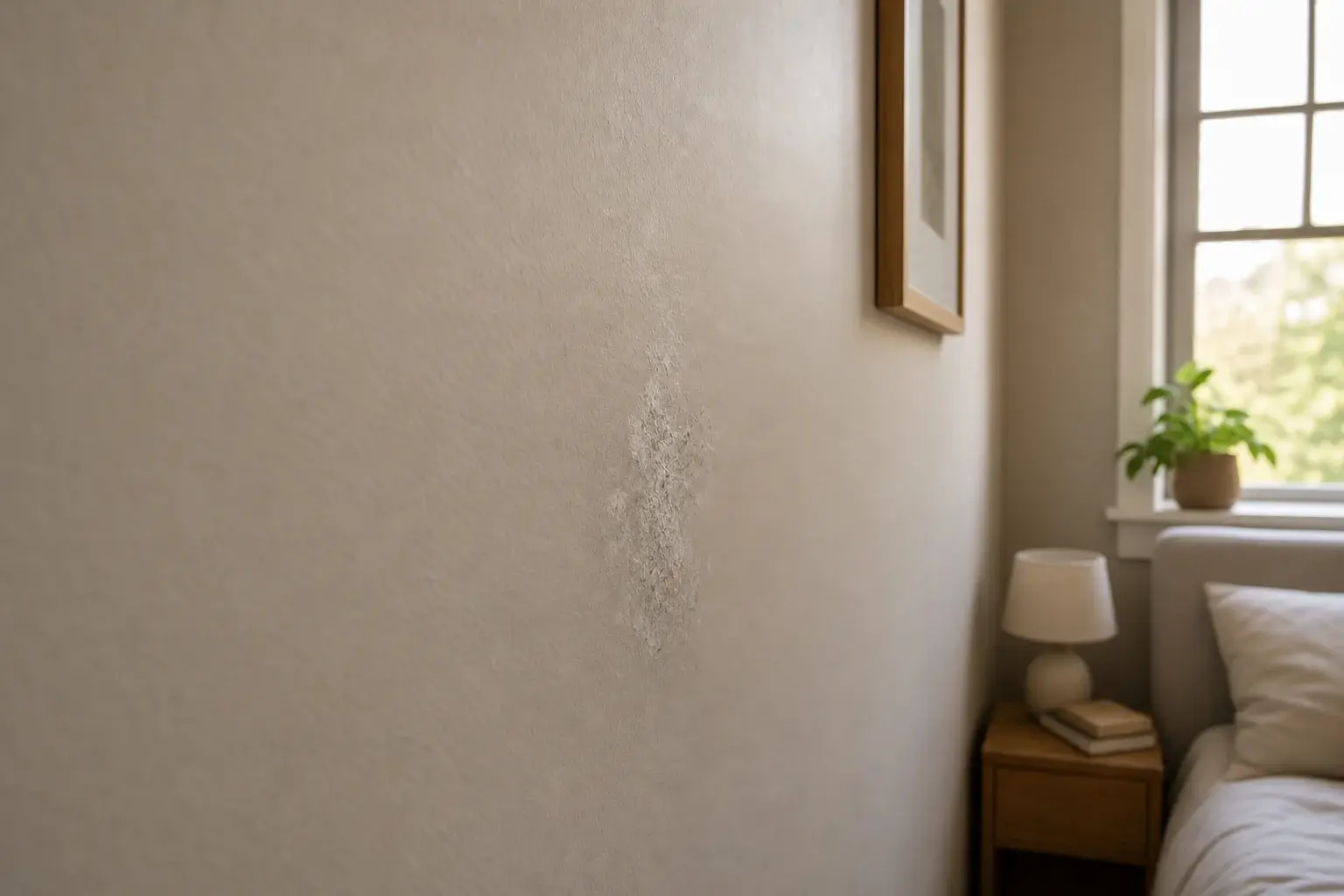
In short: because the landlord frequently does not own the defect causing it. Damp in a rented flat often starts in a roof, a gutter or a wall that belongs to the freeholder, and the law is about to put fixed timescales on fixing it anyway.

Updated 20 October 2026

This is part of What have landlords ever done for us? The 2026 data, our analysis of what the private rented sector actually delivers, drawn from the English Housing Survey, HMRC and Ministry of Justice figures.

The key facts

  • The consultation is open now. MHCLG opened its consultation on extending Awaab's Law to private rented tenancies on 9 October 2026. It closes at 11:59pm on 18 December 2026.
  • 24 hours, 10 working days, 12 weeks. The timescales social landlords already work to for immediately dangerous hazards, investigating serious hazards, and starting longer-term repairs. The consultation asks whether private landlords should match them.
  • 11% against 47%. Surveyor-recorded damp in private rented homes, against the share of private renters who report condensation, damp or mould themselves. English Housing Survey 2024-25, published 9 July 2026.
  • £10,569. Mean cost of bringing a non-decent private rented home up to standard, against £6,918 for a housing association home.
  • Up to £7,000. The civil penalty a council can now impose for a Category 1 hazard, following the Housing Health and Safety Rating System reform of 23 June 2026.

In this article:

  1. Who is legally responsible for damp and mould?
  2. Why can a leaseholder landlord be unable to fix it?
  3. Why is damp so hard to diagnose?
  4. Is condensation the tenant's fault?
  5. Can energy efficiency work cause damp?
  6. What does a proper repair actually involve?
  7. What will Awaab's Law require of private landlords?
  8. What should a landlord do before the rules land?

Who is legally responsible for damp and mould?

The landlord, in almost every case, and through three separate routes.

Section 11 of the Landlord and Tenant Act 1985 covers the structure and exterior and the installations for water, heating and sanitation. Penetrating damp from a failed roof, a blocked gutter or a cracked external wall sits squarely inside it, and section 12 makes void any clause trying to move that onto the tenant.

Section 9A goes further. Inserted by the Homes (Fitness for Human Habitation) Act 2018, it requires the property to be fit to live in throughout the tenancy, and damp and mould is one of the matters a court looks at in deciding fitness. The practical difference is that section 11 requires something to have broken, while section 9A can bite on a property that was never adequate.

Then there is the Housing Health and Safety Rating System, which councils enforce. Damp and mould growth is one of the assessed hazards, and since the reform of 23 June 2026 a council can impose a civil penalty of up to £7,000 at the point it first takes enforcement action.

So the liability is not in doubt. What follows is about why discharging it is harder than the headline figures suggest.

Why can a leaseholder landlord be unable to fix it?

Because the defect is on the other side of a lease boundary. Most London flats are leasehold, which means the roof, the external walls, the guttering, the downpipes and the shared drainage are almost always demised to the freeholder.

A landlord whose tenant has damp running down an internal wall from a failed parapet cannot lawfully go up and repair the parapet. They can report it, chase it, and in time take action against the freeholder, but major works to a block run through a consultation process and a service charge, and they move at the building's pace rather than the tenancy's.

The same applies when the source is the flat above or next door. There is no right of access to someone else's home, and no quick remedy that produces a dry wall this month.

The law half recognises this. Section 9A does not make a landlord liable where the unfitness could only be remedied with the consent of a third party, such as a freeholder or a neighbour, and that consent cannot be obtained despite reasonable efforts. That exception is narrow, it requires the landlord to have actually tried, and it does not touch section 11 or the council's HHSRS powers. It is a defence in a county court claim, not a reason the tenant stops living with mould.

Why is damp so hard to diagnose?

Because three different problems look identical on a wall and need completely different fixes.

Penetrating damp comes from outside, through a defect in the fabric. Rising damp comes up from the ground where there is no damp proof course or it has failed. Condensation forms when warm moist air meets a cold surface, and it is by volume the largest category of the three.

Getting this wrong is expensive in both directions. The default contractor answer is a chemical injection damp proof course, which is frequently sold for problems it cannot solve, and a landlord can spend several thousand pounds and still have a tenant reporting damp. The gap between 11% of private rented homes with surveyor-recorded damp and 47% of private renters reporting damp themselves is mostly condensation, which is to say mostly a problem with no single defect to repair.

Is condensation the tenant's fault?

Sometimes a contributing factor, almost never a usable answer.

Household moisture is real. Drying laundry indoors, covering or switching off extract fans, and keeping windows shut in winter all raise the moisture load, and a tenant doing all three in a cold flat will get condensation.

Two things make it a poor defence. The first is legal: section 9A asks whether the property is fit, and a home that cannot reasonably be kept free of condensation given how people actually live in it is unfit whatever the occupier does. The behaviour exception exists but it is narrow.

The second is practical. The dominant driver of condensation is not carelessness but cost. A tenant who cannot afford to heat the property will get cold surfaces, and cold surfaces produce condensation no matter how diligently anyone wipes them down. Telling that tenant to open a window in January is not advice they can act on.

What does work is fixing the thing the landlord controls: extract ventilation that actually extracts, trickle vents that are open, insulation on the cold spots, and heating that is cheap enough to run. Those change the outcome. A conversation about lifestyle does not.

Can energy efficiency work cause damp?

Yes, and this is the part of the 2030 deadline that gets least attention.

Retrofitted cavity wall insulation can fail and bridge the cavity, letting water cross to the inner leaf. Internal wall insulation fitted without proper vapour control moves the dew point inside the build-up and produces interstitial condensation, which is damp you cannot see until the plaster fails. And new airtight windows reduce air changes, so the same household moisture that used to leak out through draughts now has nowhere to go.

The result is that a property can be draughty and dry in 2026 and airtight and mouldy in 2031, having done exactly what it was told to do. Every sensible retrofit specification treats ventilation as part of the works rather than an afterthought, which is why the EPC C deadline and the damp problem are the same problem.

Our guide to EPC rules for landlords covers what the 2030 standard involves and the £10,000 cost cap that goes with it.

What does a proper repair actually involve?

More than most people expect, which is the reason so many owners reach for a dehumidifier instead.

Where the cause is structural, the work runs to opening up: floors lifted, plaster hacked off to a height, the defect traced and repaired, then a drying period of weeks before anything is replastered and redecorated. That sequence is close to impossible around a tenant in occupation, and there is no clean route to a temporary decant in the private rented sector.

The cost explains the rest. The mean cost of bringing a non-decent private rented home up to standard is £10,569, against £6,918 for a housing association home and £7,201 for a council one, reflecting an older and more converted stock. For a renter in a non-decent home, the median cost of putting it right is equivalent to about five months of rent, and in a third of cases more than a year's worth.

None of that is a legal defence and it is not offered as one. Landlords carry the liability whether or not they own the cause. But policy built on the assumption that the problem is indifference will not fix a problem caused by leasehold structure, old fabric and cost.

What will Awaab's Law require of private landlords?

Fixed timescales, though the exact ones are still being decided. MHCLG opened its consultation on extending Awaab's Law to private rented tenancies and to licences on 9 October 2026, and it closes at 11:59pm on 18 December 2026.

Social landlords already work to a defined clock: make immediately dangerous hazards safe within 24 hours, investigate serious hazards within 10 working days, and begin longer-term repairs within 12 weeks. The consultation asks whether private landlords should be held to the same timetable, and acknowledges the differences in how the sector operates.

The National Residential Landlords Association has backed the principle while arguing the detail has to reflect how private letting actually works. Most landlords own one or two properties and have no in-house repair team, qualified trades take time to book, and a temporary make-safe will sometimes be the right first step. Its chief executive Ben Beadle made the point that the law only matters if it is enforced consistently.

No commencement date has been set, and separate regulations are required after the consultation closes. Alongside it, the reformed Decent Homes Standard applies to the private rented sector from 2035, confirmed by government in January 2026.

What should a landlord do before the rules land?

Three things, none of which require waiting for the consultation to close.

Deal with the reporting route first. Under a timescale regime the clock starts when the tenant tells you, so a reported problem sitting in a personal inbox for a fortnight is the thing that will cause trouble. A logged, dated record of every report and every response is the single most useful change most landlords could make this year.

Second, diagnose before you spend. Paying a competent independent surveyor to establish which of the three damp types you are dealing with is cheaper than paying a contractor to fix the wrong one.

Third, if the property is a leasehold flat, start the freeholder conversation early and in writing. Reasonable efforts count for nothing unless they are evidenced, and a paper trail that begins the week the tenant reports it carries far more weight than one that begins when the council gets involved.

Sources

This article is general guidance, not legal advice, and reflects the law in force in England at the time of writing.

Download the full report: What have landlords ever done for us? The 2026 data. Twenty pages covering repairs, deposits, condition and eviction, with every figure sourced.

Hello Neighbour gives landlords the tools to let and manage a property properly without a high street agent's fee. See how fixed-fee management works.

You might also find these useful