







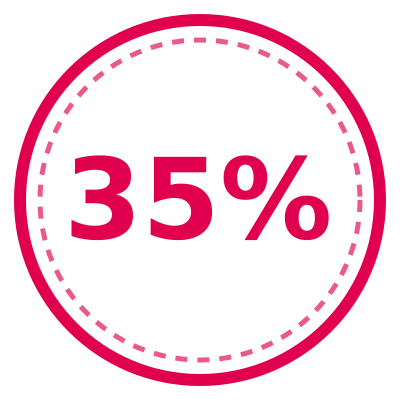





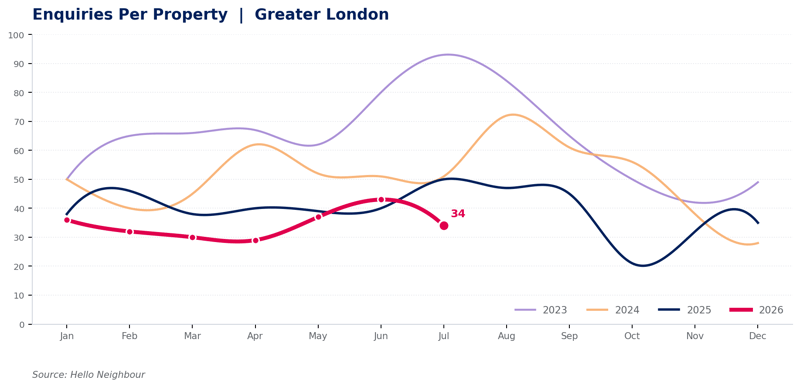
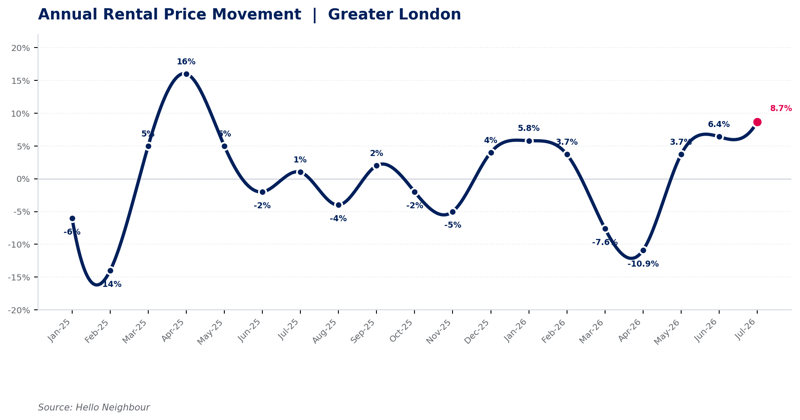
Two numbers moved in opposite directions in July, and that is the real story in this month's data. Advertised rents across Greater London finished 8.7% higher than the same month last year, our third consecutive monthly rise and the strongest reading since April 2025. Over exactly the same period, enquiries per property fell to 34, down from 43 in June, in the month that is normally the busiest of the London year.
Prices climbing while demand drops away is not how a rental market behaves. When those two lines separate this sharply, it is almost never because tenants have suddenly decided to pay more. It is because something has changed in how properties are being priced, and three months into the Renters' Rights Act the evidence points to it inflating rents through two separate channels.
The first is the asking price itself. Landlords can no longer accept an offer above the advertised figure, so the listed rent has become an opening position rather than a price. The second sits behind it, in what tenants actually sign. Goodlord, whose index measures achieved rents from confirmed tenancy contracts rather than listings, attributes June's sharp rise to the fact that landlords can now only raise the rent once a year through a Section 13 notice, which gives them a reason to set opening rents higher than they once would have.
Put those together and advertised rents end up the most inflated number in the market: a listing premium sitting on top of an opening rent that has already been pushed up. The practical consequence is that the figure on a portal is drifting away from what a property is worth on the open market, and that gap matters a great deal more than it used to.
Demand fell sharply in the month it usually peaks
The fall in enquiries is steep and badly timed. July is when students, graduates and corporate movers are all in the market at once, and in each of the last three years the month has been at or near the annual high. We recorded 50 enquiries per property in July 2025, 51 in July 2024 and 93 in July 2023. This July came in at 34.
That puts us 32% below the same month last year, the widest year on year gap of any month in 2026, and down more than a fifth on June alone. Demand is still comfortably ahead of national benchmarks, which sit at around 8 to 12 enquiries per property depending on the measure, so this is a market cooling from a very high base rather than one in difficulty. But a drop of this size in July is unusual, and it is the number we are watching most closely going into the autumn.
Why asking prices are climbing anyway
Since 1 May, the Renters' Rights Act has prohibited landlords and agents from accepting any offer above the advertised asking price. That single rule changes the incentives on pricing completely.
Before May, listing slightly under market was a rational tactic. It generated competing offers, and in a market running at 50 enquiries per property those offers frequently landed above the asking figure. That route is now closed. The advertised rent is a hard ceiling, and the only direction available once a property is live is downwards. So a response, and one we are clearly seeing across the portals, is to advertise above what you expect to achieve and treat the listed figure as an opening position rather than a price. We should be clear that we are not recommending it, for reasons we come to below.
That lifts advertised rents across the whole market without a single tenant paying more. It also explains the divergence: our price series measures what landlords are asking, and our enquiries series measures how tenants are responding. The first is being pushed up by the rules. The second is telling you what the market actually thinks.
The gap between advertised and achieved rents
We can put a number on the inflation by setting our figures against an index that measures signed contracts rather than listings. HomeLet tracks achieved rents on the new tenancies it references, and had London up 5.0% in June and 6.0% in July. Ours were 6.4% and then 8.7%. So the gap between what is advertised and what tenants actually sign widened from 1.4 percentage points to 2.7 in the space of a month. That is one index, measured the same way in consecutive months, which is why we trust it more than any single reading: achieved rents are rising, but advertised rents are pulling away from them.
Goodlord's index points the same way and offers an explanation for why the achieved figure is climbing at all. It is built from verified tenancy contracts, specifically to exclude aspirational listing prices, and it had London new lets up 5.6% year on year in June. Their CEO, William Reeve, attributed that jump to the Act's limits on raising rent during a tenancy, noting that with increases now restricted to once a year via Section 13 there is a clear incentive to begin new tenancies at higher rates
.
So the same legislation is pushing both ends of the market up by different routes. Landlords are opening tenancies higher because they only get one attempt at an increase each year, and then advertising higher still because the asking price is a ceiling they cannot exceed. It is the second effect that has accelerated in July.
What this means for Section 13 rent reviews
This is where the gap stops being an interesting statistic and starts costing landlords money. Since 1 May, a Section 13 notice on Form 4A is the only lawful way to increase the rent on an Assured Periodic Tenancy, and the proposed figure has to be no higher than open market rent. If a tenant refers the notice to the First-tier Tribunal, the Tribunal determines that open market rent from comparable evidence put forward by both sides.
Two features of the new regime make accuracy essential. The Tribunal can now only confirm the landlord's proposed figure or reduce it, never increase it, so there is no upside whatsoever in proposing high. And the referral fee for the tenant is £47, which means a challenge costs them almost nothing and delays the increase while it runs.
Now put that next to a market where portal asking prices are running roughly three points ahead of achieved rents. A landlord who builds a Section 13 increase off what similar properties are advertised at is building it off inflated evidence, and inflated evidence is exactly what gets picked apart at Tribunal. Achieved lettings are what stand up: what comparable properties actually let for, how long they took, and what the subject property itself last achieved.
To be fair to the numbers, achieved rents on new lets have risen, so comparables drawn from real lettings will legitimately come out higher than a year ago. The point is narrower than that. Asking rents inflate on top of an already-raised base, so they overstate even the genuine increase. They were always the weaker form of evidence. Under the new rules they are becoming actively misleading, and the gap is widening month by month.
The Act is not the only thing moving demand
It would be too neat to lay the fall in enquiries entirely at the door of the Renters' Rights Act, and we do not think that is what is happening. The larger structural change is migration. Net migration to the UK fell to 171,000 in the year to December 2025, down from 331,000 the year before and from a peak of 944,000 in the year to March 2023. The main driver was work-related arrivals from outside the EU, which nearly halved in a single year. London takes a disproportionate share of work migration, so a fall on that scale removes a substantial slice of rental demand from the capital regardless of anything in the legislation.
That reframes the last few years rather than undermining the argument. Rents surged through 2022 to 2024 while migration was running at record levels, and the unwind since has tracked migration falling away. On the demand side, the Act is one factor among several, and probably not the largest.
Which is precisely what makes the pricing behaviour stand out. In a market shedding demand this quickly, and with affordability still the tightest in the country, advertised rents should be softening. They are doing the opposite. Earnings have grown faster than rents for around 18 months, easing a difficult position, but London still absorbs a far higher share of income in rent than anywhere else in the UK. That is the ceiling, and asking prices are moving away from it rather than towards it.
What this means for landlords
Price realistically, and do not chase the headroom. The advertised rent is now the maximum you can accept, so building in a cushion is tempting. We would advise against it. With demand down by a third year on year, the void risk outweighs whatever headroom you gain, and a fortnight empty costs more than the uplift you were reaching for. Our guide to getting a rental valuation right covers how to set the figure properly.
Use achieved rents, not asking rents. For a new let or a rent review, ask what comparable properties actually let for rather than what they are listed at. The two figures have never been further apart, and only one of them holds up under scrutiny.
Keep costs under control. If achieved rents are flatter than advertised figures suggest, the other side of the ledger matters more. Fixed, transparent pricing with no ongoing letting fees and no maintenance mark ups protects your yield when the top line is not doing the work for you.
Our outlook for the rest of 2026
We expect advertised rents to keep looking stronger than the market underneath them, and the gap between asking and achieved to widen further before it settles. Anyone reading the headline figures as a guide to what tenants are paying is going to be misled for the next few months.
The more important question is demand. One weak July does not make a trend, and part of this may be timing rather than direction. But if enquiries stay at this level through August and September, when the market should still be busy, then the softness is real and asking prices will have to come back towards it. We will report it either way.
If you want to know what your property would achieve rather than what it could be advertised at, we can help. See how Get Rented Pro works.
In Case You Missed It
A few other pieces from the Hello Neighbour blog this month. Given everything above, the valuation piece is the one I would read first, because pricing has quietly become the highest stakes decision a landlord makes.
COMMENT