







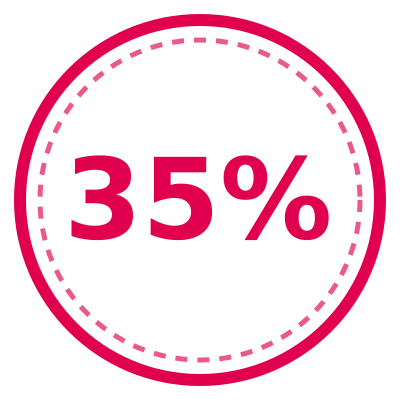
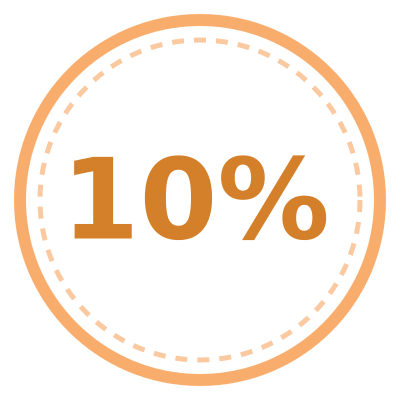




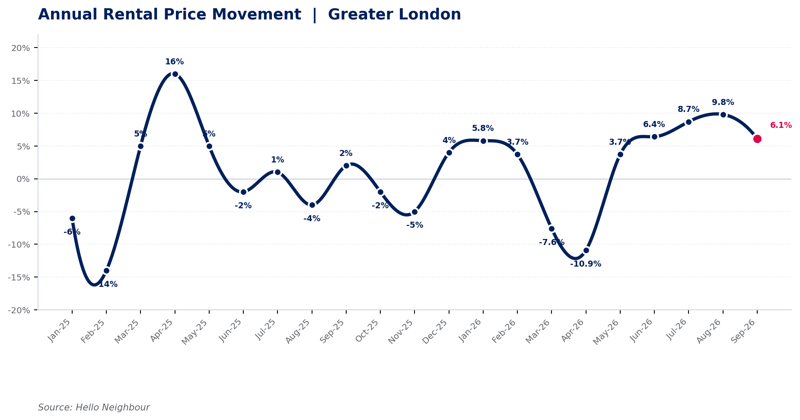
Advertised rents for the properties in Greater London that Hello Neighbour listed were 6.1% higher in September than a year earlier, at an average of £2,448. That makes five months in a row of year-on-year growth since the Renters' Rights Act came into force, although the rate has slowed from August's 9.8%. Averaged across July, August and September, rents are up around 8%, and the September average is almost 13% above where prices sat between January and April.
Part of the slowdown reflects last year's figures. September 2025 was a stronger month than August 2025 (£2,306 against £2,265), so this year's comparison had more to clear, and the average advertised rent eased by £38 between August and September. The level is still well above the first half of the year.
Why prices are holding up
We think prices have held up because supply is falling. Zoopla's Rental Market Report, published on 14 September 2026, has the number of homes available to rent in London 6% lower than a year ago, and 13% lower across inner London. Across the UK, Zoopla puts available stock 3% down and the flow of new homes onto the market 6% down, ending three years of improving supply.
Zoopla's Richard Donnell links much of this to mortgage rates. Its report estimates that the average London buyer now needs an extra £35,500 of deposit to keep repayments unchanged after this year's rate rises, which keeps would-be first-time buyers renting for longer. Zoopla also argues that market forces are doing more than the Renters' Rights Act, pointing to Scotland, where a similar tenancy system has been in place for years and the same pattern of fewer homes and faster rent growth is showing. If Zoopla is right, and with interest rates expected to rise from here, we can expect this trend to continue.
The Renters' Rights Act is still shaping how landlords set the opening rent. Since 1 May, landlords cannot accept offers above the advertised asking price, and rent increases are limited to once a year, which has encouraged landlords to list higher at the outset. Many of the conversations we are having with landlords support this, and the gap between asking and agreed rents is where its effect is clearest.
Advertised rents are not achieved rents
Our figures cover properties currently on the market, so they are advertised rents not achieved rents. Across the London properties we listed from July to September that have since let, the agreed rent came in 2.5% below the advertised rent.
How the other London measures compare
The other published measures all sit below our advertised figure. HomeLet's Rental Index for September 2026, which records rents agreed on tenancies starting that month, has London at £2,272, up 3.3% on a year earlier and 1.5% on August. Zoopla's September report has London rents up 2.9%, from 1.7% a year ago. The ONS Price Index of Private Rents, released on 16 September 2026, covers new and existing tenancies together and has London at 3.5% in the 12 months to August, up from 3.0% in July, on an average of £2,332.
Advertised rents move first and furthest, because they respond to new pricing decisions straight away. HomeLet's annual figure for London has eased from 5.1% in August to 3.3% in September, a similar slowing to our advertised figure. Comparing our 6.1% with HomeLet's 3.3%, the gap between asking and achieved looks to be around 3%. That gap is important for any landlord thinking about a valuation or a rent review.
Affordability is still the ceiling
Nationally, rent already absorbed 36.3% of the median private renting household's income in the year to March 2024, above the 30% the ONS treats as its affordability threshold, on the ONS private rental affordability series. That is why we expect hard negotiation on opening rents and agreed rents to keep running below advertised for the rest of the year, however tight supply gets.
The national picture is calmer than London's. The ONS has average UK rents at £1,400 in August 2026, up 3.8%, and attributes the rise mainly to London. Zoopla has UK rents for new lets up 2.6% to £1,343 in the year to July and expects growth to reach 4% to 5% by the end of 2026.
Demand steady but below last year
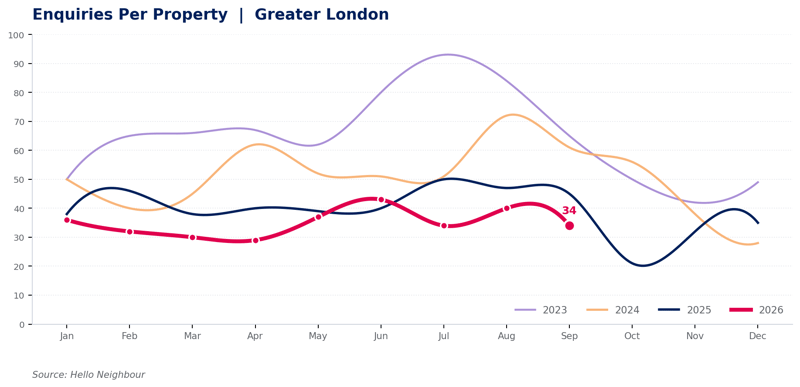
There has been no significant change in demand. We recorded 34 enquiries per property in September, down from 40 in August and below the 45 we saw in September 2025, 61 in September 2024 and 65 in September 2023. Across January to May we averaged 33 enquiries per property, and across June to September 38, so there has been a small seasonal rise, but every month this year has been lower than the same month in 2025.
What this means for you
Price accurately from day one. The advertised rent is now the most you can accept. Tighter supply gives you some support, but agreed rents on our own lets are coming in below asking. Base the figure on what comparable properties actually let for, and our guide to getting a rental valuation right covers how.
Get the right tenant in at the start. Section 21 has gone and every new let is an Assured Periodic Tenancy, so ending a tenancy is slower and harder than it was. Referencing, affordability checks and a proper conversation before move in matter more now than ever. Our guide to how to find a tenant yourself covers each step.
Keep your costs under control. When agreed rents sit below asking, the difference comes out of your yield. Fixed, transparent pricing with no ongoing letting fees and no maintenance mark ups protects it.
Our outlook for the rest of 2026
We expect advertised rents to stay above last year through the autumn. Supply is tight, and our readings for October and November 2025 were weak, so the comparisons get easier from here. We do not expect demand to rise much from current levels, and with affordability where it is, we expect agreed rents to keep trailing asking prices. The distance between the two is the figure we will keep reporting each month.
If you want to know what your property would achieve rather than what it could be advertised at, we can help. See how Get Rented Pro works.
Where these numbers come from
- Hello Neighbour. Advertised rents and enquiries per property across the Greater London properties we market, September 2026, compared with the same month in earlier years. These are advertised rents, not achieved rents, and they cover our own stock rather than the whole London market. Achieved rents compare the agreed rent with the advertised rent on the same Greater London properties listed July to September 2026. The September gap of around 3% between asking and achieved is an estimate, comparing our advertised figure with HomeLet's.
- Zoopla, UK Rental Market Report, September 2026, published 14 September 2026, data to July 2026. UK £1,343, up 2.6%. London up 2.9%. Available homes 6% lower in London and 13% lower in inner London.
- HomeLet, Rental Index, London, September 2026. London £2,272, up 3.3% annually and 1.5% monthly, based on rents agreed on tenancies starting that month. August 2026: £2,238, up 5.1%.
- ONS, Private rent and house prices, UK: September 2026, released 16 September 2026, data to August 2026. London 3.5% on an average of £2,332. UK £1,400, up 3.8%.
- ONS, Private rental affordability, England, financial years ending March 2016 to 2024.
In Case You Missed It
Two new guides this month. Start with the landlord database: registration opens on 15 December at £65 per property a year, and the guide sets out the dates by region, what you need to have ready and the 28-day rule.
COMMENT