








Updated 30 October 2026
The key facts
- 24%, 44% and 49% from 6 April 2027. Property income tax rises four points, and the mortgage interest credit rises from 20% to 24% with it. HMRC policy paper, 29 October 2026.
- £50 to incorporate, and stamp duty is identical. An individual buying an additional property pays the same higher rates a company pays. HMRC guidance on higher rates of SDLT.
- £42,604 to £66,697 to move a property you already own. Stamp duty on the full value, capital gains tax on the whole gain, plus refinancing. Hello Neighbour modelling, October 2026.
- 47.96% if you take the profit out. 19% corporation tax then 35.75% dividend tax, against a 44% property higher rate. HMRC Annex A, 28 October 2026.
- 93% of landlords own in their own name. 63% earn under £20,000 of gross rent a year. Ipsos for HMRC, Research Report 804, 20 May 2025.
In this article:
- What did the Budget change for landlords?
- Should I buy my next property through a company?
- Should I move a property I already own into a company?
- Does a company help a basic-rate landlord?
- What happens when I take the money out?
- Where could these numbers be wrong?
- What should I actually do?
- Sources
What did the Budget change for landlords?
Property income tax rates rise to 24% for basic-rate taxpayers, 44% for higher-rate and 49% for additional-rate on 6 April 2027, confirmed by HM Revenue & Customs in its policy paper of 29 October 2026. The rates apply in England, Wales and Northern Ireland. HMRC estimates an average rise of £225 a year for affected taxpayers in 2027/28, and expects 2.4 million landlords to be affected by 2031/32.
Measured against the rates landlords pay today, the increase is four percentage points. The November 2025 Budget had already legislated property rates of 22%, 42% and 47% from April 2027, and Budget 2026 adds two points on top. Nothing changes in the current 2026/27 tax year, when property income is still taxed at the main rates of 20%, 40% and 45%.
Corporation tax has not moved. HMRC's Annex A of 28 October 2026 confirms 19% on company profits up to £50,000 and 25% above £250,000 for the 2026/27, 2027/28 and 2028/29 financial years. A company also deducts its mortgage interest in full, where an individual receives only a credit, worth 24% of the interest from April 2027. The gap between the two routes has widened twice in twelve months, which is why the question keeps coming up.
We modelled the change on the four properties from our Landlord Economics research: an average London property at £542,000 letting for £26,244 a year, and an average property outside London at £251,000 letting for £14,892, each shown owned outright and with a 75% loan-to-value interest-only mortgage at 5.0%. On those properties the rise costs between £446 and £755 a year, two to three times HMRC's stated average, because these properties earn more than the typical landlord does.
Should I buy my next property through a company?
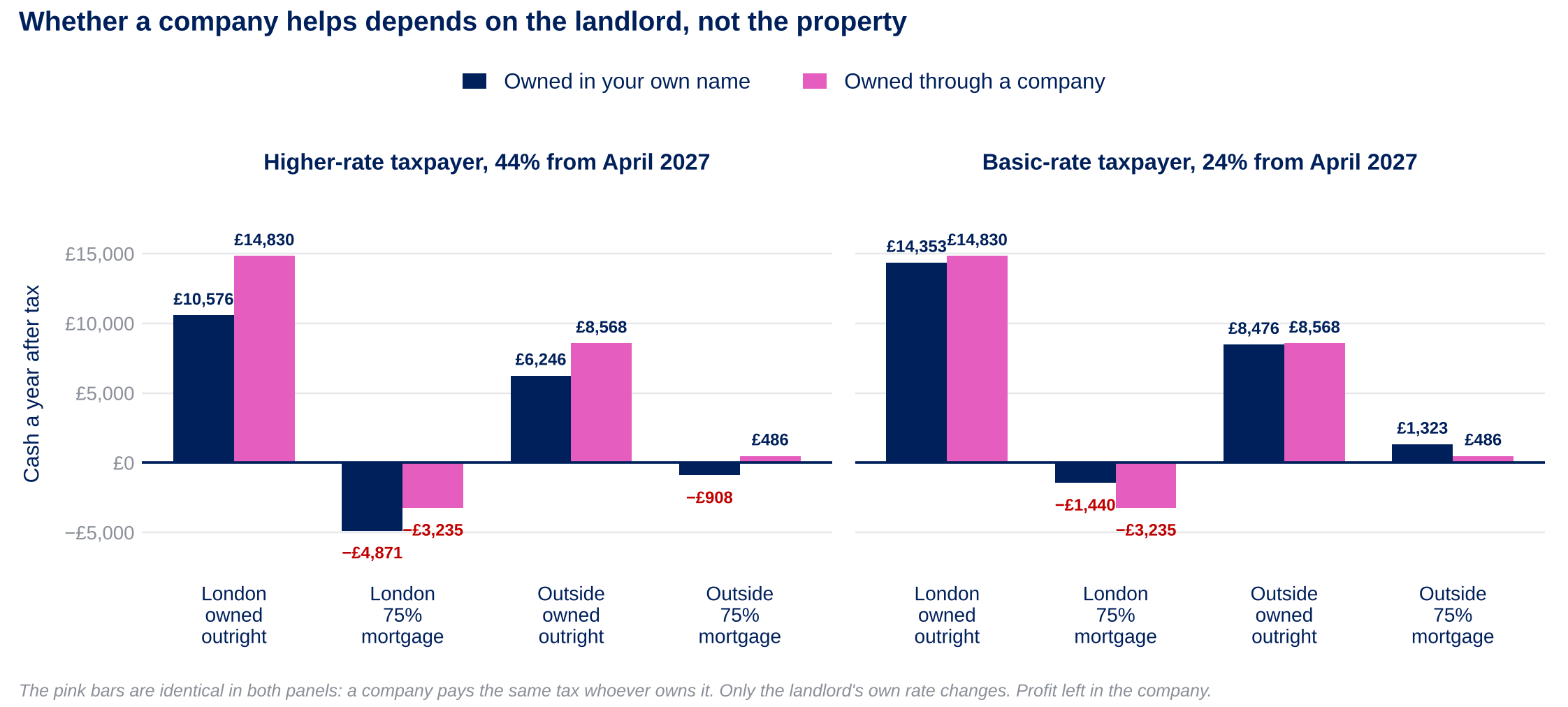
Yes, if you pay higher-rate tax: on our four worked properties a company keeps between £1,394 and £4,255 a year more than the same landlord owning personally, after paying both the higher company mortgage rate and the cost of filing accounts.
The reason is Section 24. A landlord in their own name pays tax on the rental profit before the mortgage interest comes out, and receives a credit against that interest at the property basic rate, 24% from April 2027. On the London mortgaged property that means paying £3,432 of tax on a property that loses £4,871 in cash, because HMRC taxes a profit of £18,885 that the landlord never sees. A company deducts the whole £21,545 interest bill, records a genuine loss of £3,235 and pays nothing.
Two costs landlords expect to be higher in a company are not. Stamp duty is identical, because an individual buying an additional residential property pays the same higher rates a company pays: £44,200 on the London property and £15,100 on the one outside London. Incorporation itself costs £50 at Companies House. The genuine extras are a mortgage rate roughly 0.30 percentage points higher, which BuytoLetFinance put at a range of 0.20 to 0.40 points at 75% loan-to-value in May 2026, and around £576 a year to run the company, based on GetGround's published Core price of £48 a month including VAT for a single property. Both are already inside the figures above.
One administrative point catches out company owners of larger properties. A company owning a UK dwelling worth more than £500,000 falls within the Annual Tax on Enveloped Dwellings, which covers our London example at £542,000. A property let commercially to unconnected tenants should qualify for relief, but the relief is not automatic: HMRC requires a Relief Declaration Return by 30 April each year, and charges penalties and interest for filing late.
Most new buyers have already reached this conclusion. Hamptons reported in February 2026 that around three-quarters of new buy-to-let purchases are now made through a limited company, and that 66,587 new buy-to-let companies were registered in 2025, a record.
The exception: buyers who own no other property
A company always pays the 5% additional-dwellings surcharge, from a purchase price of £40,000, while an individual who owns no other property does not. A tenant buying their first property as an investment would pay £17,100 in their own name on the London property against £44,200 through a company, a penalty of £27,100. That buyer needs more than six years of tax saving to return to level, and only if they pay higher rate.
Should I move a property I already own into a company?
Almost never. Moving a single property in costs between £42,604 and £66,697 on our four examples, and takes a higher-rate landlord 13.5 to 40.8 years of tax saving to recover.
Paragon Bank research published on 13 January 2026, covering more than 500 landlords, found that 32% intend to transfer properties they currently hold in their personal name into a company. On our numbers, most of them should not.
A transfer to your own company is treated as a disposal at market value between connected parties. The company pays stamp duty on the full value even though no money changes hands at arm's length, and the landlord pays capital gains tax on the entire gain since purchase. Any mortgage has to be redeemed and replaced, because a personal buy-to-let mortgage cannot follow the property into a company.
The table assumes the landlord bought in August 2016 and that the property tracked the HM Land Registry UK House Price Index since. On that basis London rose 9.7% over the decade, because August 2016 sat close to the London peak, while Manchester rose 74.3%. That single difference explains why the columns look so unalike.
| One-off cost of moving it in | London, owned outright | London, 75% mortgage | Outside London, owned outright | Outside London, 75% mortgage |
|---|---|---|---|---|
| Stamp duty, charged on the full value | £44,200 | £44,200 | £15,100 | £15,100 |
| Capital gains tax at 24% on the whole gain | £10,817 | £10,817 | £24,954 | £24,954 |
| Legal costs, both sides | £2,500 | £2,500 | £2,500 | £2,500 |
| Redeeming and replacing the mortgage | – | £9,130 | – | £4,765 |
| Company formation | £50 | £50 | £50 | £50 |
| Total cost of moving it in | £57,567 | £66,697 | £42,604 | £47,369 |
| Tax saved a year, higher-rate taxpayer | £4,255 | £1,636 | £2,322 | £1,394 |
| Years to get the money back | 13.5 | 40.8 | 18.4 | 34.0 |
The one-off bill is at least seventy-five times what the tax rise costs in a year. A basic-rate landlord never recovers it, because there is no annual saving to recover it with.
The London property shows how the two taxes pull against each other. Its gain since 2016 is small, so the capital gains tax bill is only £10,817, but stamp duty is charged on the whole £542,000 value while the gain is only £48,072, so it comes to £44,200. Outside London the position reverses: £15,100 of stamp duty against £24,954 of capital gains tax.
The relief that changes the answer
Incorporation relief under section 162 of the Taxation of Chargeable Gains Act 1992 holds the gain over into the base cost of the company shares, so no capital gains tax falls due on the transfer. It applies only where the lettings are run as a genuine business rather than a passive investment, which in practice means a real portfolio with real time spent on it. A single property will not qualify. Anyone with a portfolio that might should take specialist advice before relying on it, because it is the largest single variable in the table above.
Schemes that promise to avoid all of this
HMRC published Spotlight 63 in October 2023 and Spotlight 63a in 2024 stating that hybrid partnership arrangements marketed to landlords do not work. These schemes route a property business through a limited liability partnership with a corporate member, and promise to sidestep Section 24 without the stamp duty and capital gains tax of a straight transfer. HMRC is challenging them. An offer of one is a reason to find a different adviser.
Does a company help a basic-rate landlord?
No. A company leaves a basic-rate landlord £1,796 a year worse off in London and £837 worse off outside it on the mortgaged properties, and ahead by only £478 and £91 on the two owned outright.
From April 2027 the mortgage interest credit is given at 24%, exactly the rate a basic-rate landlord pays, so the relief is complete and Section 24 costs them nothing at all. A company has nothing left to improve on, and it still carries a mortgage rate 0.30 percentage points higher plus around £576 a year in filing costs. On the London mortgaged property that rate premium alone costs £1,220 a year, more than the entire tax difference between the two structures. The two small gains on the unmortgaged properties both turn negative once the landlord takes the money out.
This matters more than the headline advice suggests, because basic-rate landlords are the great majority of the market. Ipsos, in Research Report 804 for HMRC published on 20 May 2025, found that 93% of landlords own as individuals, 63% earn less than £20,000 in gross annual rent and 52% make less than £10,000 of profit a year. Our analysis of HMRC's property rental income statistics found landlord costs now take 59p in every pound of rent.
What happens when I take the money out?
A higher-rate landlord pays 19% corporation tax and then 35.75% dividend tax above the £500 allowance, a combined 47.96%, against the 44% property higher rate they were trying to escape.
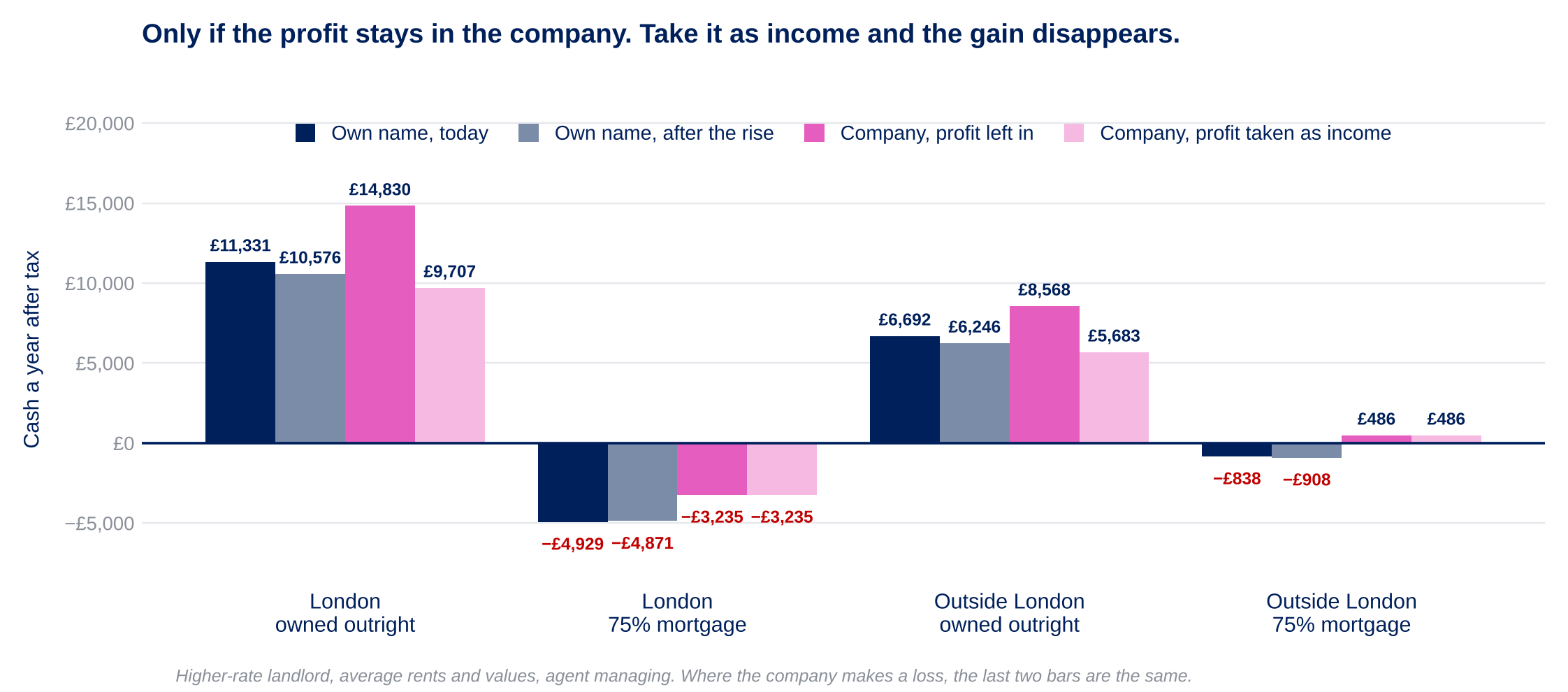
Every company advantage described above assumes the profit stays inside the company. The effect of taking it out shows most clearly on the properties owned outright. In London a higher-rate landlord keeps £10,576 a year in their own name and £14,830 in a company, but only £9,707 once the dividend is paid. Outside London the same comparison runs £6,246, £8,568 and £5,683. In both cases a landlord who needs the rent to live on ends up behind where they started.
Our reading is that incorporation suits reinvestment and works against income. It works for a landlord building a portfolio who leaves the profit in the company to fund the next deposit. It works against a landlord drawing the rent as income, which describes most of the 78% of landlords who told HMRC's researchers that letting is a supplementary income rather than their main earnings.
Where could these numbers be wrong?
Three things could move these numbers: the Finance Bill is not yet law, the capital gains figures rest on an assumed purchase date, and we have deliberately left some costs out.
The measures are proposals until the Finance Bill 2026-27 receives Royal Assent. The rates themselves are set out in HMRC's policy paper of 29 October 2026, and the treatment of mortgage interest relief in HM Treasury's Budget 2026 policy costings, which state that finance cost relief "will continue to be aligned to the property basic rate". We have modelled the credit at 24% on that basis. An earlier version of this article used 20% and was wrong.
The capital gains figures assume a purchase in August 2016. A landlord who bought five years ago faces £1,297 on the London property against £10,817, and one who bought fifteen years ago faces £55,289. The transfer arithmetic is extremely sensitive to this, and no two landlords are the same.
We have also left things out. These figures exclude voids, licensing, ground rent and service charge, exactly as in our Landlord Economics research, and they exclude early repayment charges on any mortgage still inside a fixed rate, which run to several thousand pounds. All of those push in the same direction, which is against transferring.
What should I actually do?
Buy new in a company if you pay higher rate, leave an existing property where it is, and stay in your own name if you pay basic rate.
For a higher-rate buyer the company costs £50 to set up, stamp duty is the same either way, and the saving starts in year one. For an existing owner, leave the property where it is unless an accountant has modelled your position and incorporation relief is genuinely available, which for a single property it will not be. For a basic-rate landlord the company is likely to cost money. Our landlord tax page sets out the returns and deadlines that apply either way.
And whichever structure you are in, the tax rise is £446 to £755 a year while a high-street letting agent charging 20.4% of rent costs £5,354 a year on the same London property. We think the effort belongs on the larger number. Our Landlord Economics research found that managing the property yourself adds between 0.8 and 2.8 percentage points to return on equity, several times what any change of ownership structure delivers.
For the wider pros and cons of company ownership, including pensions, joint ventures and the practical realities of personal guarantees, Suzanne Smith's guide to limited companies for landlords, updated 28 October 2026, covers ground that numbers alone do not.
Sources
Legislation
- Taxation of Chargeable Gains Act 1992, section 162, incorporation relief.
Government
- HMRC, Income Tax: changes to tax rates for property and savings income, 29 October 2026.
- HMRC, Budget 2026 Annex A: rates and allowances, 28 October 2026.
- HMRC, Higher rates of Stamp Duty Land Tax, updated 1 April 2025.
- HMRC, Stamp Duty Land Tax: corporate bodies, updated 2 May 2025.
- HMRC, Annual Tax on Enveloped Dwellings, updated 4 March 2026.
- HMRC, Property business arrangements involving hybrid partnerships (Spotlight 63), October 2023.
- Ipsos for HMRC, Research Report 804: Landlord behaviour, 20 May 2025.
- HM Land Registry, UK House Price Index, August 2026 release.
Sector
- Hamptons, Record 66,587 buy-to-let companies set up in 2025, February 2026.
- Paragon Bank, How limited company ownership is becoming the new normal, 13 January 2026.
- BuytoLetFinance, Buy-to-let mortgage rates 2026, May 2026.
- GetGround, published pricing, October 2026.
- UK Landlord Tax, Budget 2026 for landlords, 28 October 2026.
- The Independent Landlord, Limited company for landlords: the pros and cons, 28 October 2026.
This is general guidance and not tax or legal advice. Hello Neighbour is a letting platform, not a tax adviser. The figures are worked illustrations on published rates and published data, for the law in force in England at the time of writing. No landlord should move a property on the strength of a blog post.
The full workings, including the four worked profit and loss accounts, the assumptions, the sensitivities and all the sources, are in our 17-page analysis. Download the full analysis (PDF).
The structure you own in is worth a few hundred pounds a year. What you pay your agent is worth thousands.
COMMENT